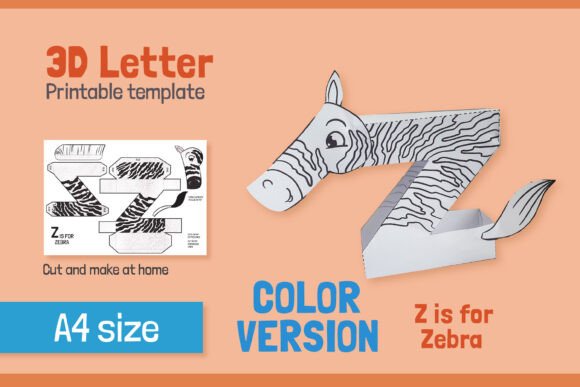
Strategic Value of the Letter Z 3D Papercraft for Kids – COLOR in Educational Design
In the landscape of early childhood education and creative development, resources are often evaluated solely on their immediate entertainment value. However, a more strategic approach considers how specific tools contribute to long-term cognitive and motor skill acquisition. The Letter Z 3D Papercraft for Kids – COLOR represents more than a simple pastime; it is a structured activity designed to bridge the gap between abstract recognition and tangible understanding. By focusing on the letter Z, specifically associated with the zebra in this vibrant color version, educators and parents can leverage a high-engagement tool that supports fine motor development, spatial reasoning, and alphabetical literacy simultaneously.
This resource is not merely a printable sheet; it is a curated experience. The inclusion of a high-resolution 300 dpi JPEG and a dedicated PDF file with a linked assembly video ensures that the barrier to entry is low while the quality of output remains high. For decision-makers in educational settings, from homeschooling parents to classroom teachers, understanding the underlying mechanics of such tools allows for better integration into broader learning objectives.
Enhancing Fine Motor Skills Through Structured Assembly
The physical act of creating a 3D object from a 2D plane requires a sophisticated coordination of hand-eye movements. When children engage with the Letter Z 3D Papercraft for Kids – COLOR, they are not just coloring; they are executing a series of precise actions. Cutting along defined lines demands control and patience. Folding along creases requires an understanding of pressure and direction. Gluing tabs necessitates accuracy and timing.
These actions are critical for developing fine motor skills, which are foundational for later academic tasks such as handwriting, typing, and using scientific instruments. From a strategic planning perspective, integrating this craft into a curriculum is not about filling time. It is about intentionally targeting specific developmental milestones. The zebra theme adds a layer of contextual learning, reinforcing the association between the visual symbol "Z" and the concept it represents. This dual-coding—visual and kinesthetic—enhances memory retention and conceptual clarity.
Spatial Awareness and Cognitive Development
One of the most significant yet often overlooked benefits of 3D papercraft is the development of spatial awareness. Children must visualize how a flat, colored pattern will transform into a three-dimensional object. This mental rotation and transformation process is a key component of spatial intelligence, which correlates strongly with success in STEM fields later in life.
The Letter Z 3D Papercraft for Kids – COLOR challenges young minds to interpret two-dimensional instructions and execute them in three-dimensional space. The video link provided in the PDF serves as a scaffold, offering guidance without removing the cognitive load entirely. This balance is crucial. If the task is too easy, it fails to stimulate growth; if it is too difficult, it leads to frustration. The design of this specific craft strikes that balance, making it suitable for a wide range of ages and skill levels within the target demographic.
Strategic Integration in Classroom and Home Environments
For educators and parents, the utility of any resource depends on its ease of implementation and alignment with goals. The Letter Z 3D Papercraft for Kids – COLOR is designed with practicality in mind. The A4 format ensures compatibility with standard home and office printers, eliminating the need for specialized equipment. The high-resolution 300 dpi guarantee means that the final product will be visually appealing, which is important for maintaining student engagement and pride in their work.
Consider the following strategic approaches to using this resource:
- Thematic Units: Use the zebra-themed Z as part of a larger unit on animals, habitats, or the alphabet. It can serve as a culminating activity that reinforces previous lessons.
- Fine Motor Stations: Incorporate the craft into rotating learning stations where students practice cutting, folding, and gluing in a focused, low-pressure environment.
- Decorative Branding: For classrooms or homeschool spaces, the completed crafts can be used to create a cohesive, student-generated display. This enhances the learning environment and gives children a sense of ownership over their space.
- Parent-Child Bonding: In home settings, the activity provides a structured opportunity for collaborative work. The video guide allows parents to facilitate rather than direct, fostering independence in the child.
Risk Mitigation and Intentional Use
While the benefits are clear, there are risks associated with using such resources without clear intent. Randomly assigning crafts without connecting them to learning objectives can lead to disengagement or the perception of busy work. To avoid this, it is essential to frame the activity within a broader context. Explain to children why they are making the letter Z and what skills they are practicing. This metacognitive awareness helps them understand the purpose of the task, increasing motivation and focus.
Additionally, consider the individual needs of the learners. Some children may struggle with the precision required for cutting and gluing. Providing adaptive tools, such as safety scissors with different grip sizes or pre-folded lines for younger children, can ensure inclusivity. The video link is a valuable asset here, as it allows children to review steps at their own pace, reducing anxiety and promoting self-directed learning.
Long-Term Value and Creative Confidence
Beyond immediate skill development, engaging with the Letter Z 3D Papercraft for Kids – COLOR builds creative confidence. Completing a complex task like assembling a 3D model provides a tangible sense of accomplishment. This positive reinforcement encourages children to tackle future challenges with resilience and curiosity. For entrepreneurs and creators in the educational space, recognizing this psychological impact is key to designing effective products and experiences.
The color version of the craft also allows for personal expression. While the template provides structure, the choice of colors and shading techniques offers room for creativity. This balance between structure and freedom is ideal for fostering innovative thinking. Children learn that rules and guidelines do not stifle creativity but rather provide a framework within which it can flourish.
Practical Considerations for Implementation
Before printing and distributing the Letter Z 3D Papercraft for Kids – COLOR, consider the following logistical factors:
- Material Quality: Use cardstock or heavy paper for best results. Standard printer paper may be too flimsy to hold the 3D shape effectively.
- Tool Availability: Ensure that all participants have access to safe scissors, glue sticks, and coloring materials. Preparing these in advance minimizes disruptions during the activity.
- Time Management: Allocate sufficient time for the entire process, including coloring, cutting, drying, and assembly. Rushing the activity can compromise the quality of the outcome and the learning experience.
- Digital Access: Verify that the link to the assembly video is accessible and functional. Test it on the devices that will be used by students or parents to avoid technical frustrations.
By approaching the Letter Z 3D Papercraft for Kids – COLOR with a strategic mindset, educators and parents can maximize its educational value. It is not just a craft; it is a tool for developing essential skills, fostering creativity, and building confidence. When used intentionally, it contributes to a holistic learning experience that prepares children for future academic and personal success. The combination of high-quality design, clear instructions, and engaging content makes it a valuable addition to any educational toolkit.
Ultimately, the goal is to bring learning to life. This vibrant 3D alphabet papercraft does exactly that by transforming abstract letters into tangible, interactive objects. It invites children to explore, create, and learn in a hands-on manner that is both enjoyable and intellectually stimulating. For those committed to high-quality educational experiences, this resource offers a practical, effective, and engaging solution.