Strategic Engagement: Leveraging Letter a 3D Papercraft for Kids – COLOR in Educational and Creative Contexts
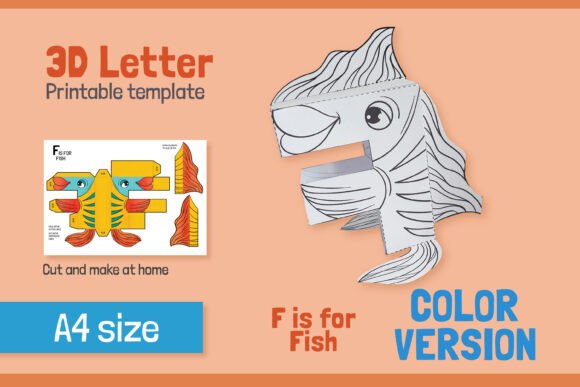
In the landscape of early childhood education and creative development, resources are often evaluated solely on their aesthetic appeal or immediate entertainment value. However, for educators, parents, and content creators who understand the mechanics of learning, the true value of a tool lies in its ability to facilitate deeper cognitive and motor skill acquisition. The Letter a 3D Papercraft for Kids – COLOR series represents more than a simple craft activity; it is a structured intervention designed to bridge the gap between abstract symbol recognition and tangible spatial understanding. By focusing on specific iterations, such as the LETTER F for FISH model, we can observe how intentional design supports broader educational and developmental goals.
This approach moves beyond passive consumption of content. Instead, it requires active participation, planning, and execution from the child, guided by the adult facilitator. When you integrate the Letter a 3D Papercraft for Kids – COLOR into your curriculum or home learning environment, you are not merely filling time. You are investing in a process that enhances fine motor skills, spatial awareness, and letter-sound association through a multi-sensory experience. The strategic utility of this tool becomes evident when we analyze its components: high-resolution printability, video-guided assembly, and the inherent challenge of three-dimensional construction.
The Strategic Value of Tangible Learning Tools
Digital interfaces dominate modern learning environments, yet there is a growing consensus among developmental psychologists and educators regarding the irreplaceable nature of tactile learning. The Letter a 3D Papercraft for Kids – COLOR capitalizes on this need for physical interaction. When a child engages with the A4 page designed for the letter F Fish, they are tasked with a complex sequence of actions: cutting along precise lines, folding along designated creases, and adhering tabs to create a stable structure. This process is not random; it is a exercise in precision and patience.
From a decision-making perspective, choosing high-quality resources like this jpeg and pdf set ensures that the technical barriers to entry are minimized. The 300 dpi resolution guarantees clean edges, which is crucial for maintaining the structural integrity of the final product. Poorly designed crafts lead to frustration, which can derail the learning objective. By selecting a resource that includes a link to an assembly video, you are also providing a scaffold for independent learning. This allows the child to develop problem-solving skills as they interpret visual instructions, a competency that translates directly to academic and professional success later in life.
Enhancing Fine Motor Skills and Spatial Awareness
The development of fine motor skills is a critical precursor to handwriting proficiency and overall dexterity. The act of manipulating paper, applying glue, and aligning small tabs requires a level of hand-eye coordination that digital tapping cannot replicate. The Letter a 3D Papercraft for Kids – COLOR is engineered to challenge these skills appropriately for young learners. Each fold and glue point serves as a micro-task that builds neural pathways associated with precision and control.
Furthermore, spatial awareness is cultivated as the child transitions from a two-dimensional flat sheet to a three-dimensional object. Understanding how a flat shape transforms into a volumetric figure is a fundamental concept in geometry and engineering. By working with the LETTER F for FISH model, children begin to grasp concepts of depth, perspective, and structure. This is not merely play; it is foundational STEM learning disguised as creative fun. For educators and parents, recognizing this dual benefit allows for more effective positioning of the activity within a broader learning framework.
Practical Implementation and Planning
To maximize the impact of the Letter a 3D Papercraft for Kids – COLOR, thoughtful planning is essential. Randomly distributing worksheets without context often results in disengaged participants and wasted materials. Instead, consider integrating the craft into a thematic unit. For example, if the focus is on marine life, the LETTER F for FISH becomes a central artifact that reinforces vocabulary, biology, and literacy simultaneously.
- Preparation: Ensure all materials are ready before beginning. Print the A4 page on cardstock for durability, though standard paper works if handled carefully. Have scissors, glue sticks, and coloring tools accessible.
- Instructional Scaffolding: Use the provided PDF link to the video tutorial. Watch it yourself first to anticipate potential difficulties. Decide whether to guide the child step-by-step or allow them to follow the video independently, depending on their age and skill level.
- Contextual Learning: Discuss the letter F and the word Fish before starting. Ask questions about the shape of the fish, the sound of the letter, and other words that start with F. This primes the brain for association.
- Reflection: After completion, discuss the process. What was difficult? How did they solve problems? This metacognitive reflection solidifies the learning experience.
By approaching the activity with this level of intentionality, you transform a simple craft into a comprehensive learning module. This method aligns with best practices in instructional design, where engagement is driven by relevance and clear objectives.
Risks of Unstructured Use
While the Letter a 3D Papercraft for Kids – COLOR is a powerful tool, its effectiveness is contingent upon proper usage. One significant risk is the tendency to prioritize speed over quality. If the goal is merely to produce a finished product quickly, the developmental benefits are largely lost. Rushing through cutting and folding denies the child the opportunity to practice precision and patience. Additionally, without proper guidance, children may become frustrated by the complexity of 3D assembly, leading to negative associations with crafting or learning tasks.
Another consideration is the mismatch between the child’s current skill level and the task’s demands. While the design is kid-friendly, it still requires a baseline level of dexterity. For younger children, adult assistance is not just helpful but necessary to prevent discouragement. Conversely, for older children, the challenge may need to be augmented with additional creative elements, such as designing their own patterns before cutting, to maintain engagement. Understanding these dynamics is crucial for making informed decisions about when and how to introduce the material.
Long-Term Benefits and Branding for Educators
For educators, bloggers, and small business owners in the educational niche, utilizing high-quality resources like the Letter a 3D Papercraft for Kids – COLOR can enhance your professional branding. Sharing well-structured, visually appealing, and educationally sound activities demonstrates expertise and commitment to student success. It positions you as a thoughtful practitioner who values depth over breadth.
When you document the process and share the outcomes, you provide social proof of the tool’s effectiveness. Parents and fellow educators are drawn to resources that offer clear value propositions. The inclusion of a video tutorial link adds a layer of professionalism and support, reducing the burden on the end-user and increasing satisfaction. This attention to user experience is a key differentiator in a crowded market of educational materials.
Making Informed Decisions for Better Outcomes
Ultimately, the decision to use the Letter a 3D Papercraft for Kids – COLOR should be driven by your specific goals. Are you aiming to improve fine motor skills? Enhance letter recognition? Create engaging classroom decor? Or perhaps foster a love for hands-on learning? Clarifying these objectives allows you to tailor the implementation for maximum impact. The versatility of the LETTER F for FISH model means it can serve multiple purposes, but only if approached with clarity.
Consider the long-term trajectory of the learner. Each successful completion of a 3D papercraft builds confidence and competence. These small victories accumulate, contributing to a growth mindset and a willingness to tackle complex tasks. By providing tools that are both challenging and achievable, you support the development of resilience and creativity. The Letter a 3D Papercraft for Kids – COLOR is not just a product; it is a catalyst for meaningful development when used with intention and strategic foresight.
In conclusion, the integration of tactile, high-quality resources into learning environments is a strategic imperative for those committed to holistic development. The Letter a 3D Papercraft for Kids – COLOR offers a robust platform for achieving diverse educational outcomes. By understanding its mechanics, planning its implementation, and mitigating potential risks, you can leverage this tool to create lasting positive impacts. Whether you are an educator designing a curriculum, a parent supporting home learning, or a creator building a brand, the thoughtful application of such resources will yield superior results compared to passive or unstructured alternatives.