Building Foundations: The Strategic Value of Hands-On Learning with Letter E 3D Papercraft for Kids – COLOR
In an era increasingly defined by digital saturation and screen-based interactions, a counter-movement is gaining significant traction among educators, parents, and creative professionals. This shift prioritizes tactile engagement and physical creation as essential components of cognitive development. At the forefront of this educational renaissance is the Letter E 3D Papercraft for Kids – COLOR, a resource that transcends simple entertainment to become a vital tool for skill acquisition. By focusing on the letter E for Elephant, this papercraft model offers more than just a colorful activity; it represents a convergence of design thinking, motor skill development, and early literacy reinforcement.
For professionals in education, child development, and even product design, understanding the mechanics behind such tools provides insight into how modern learners engage with information. The appeal of this specific craft lies not merely in its aesthetic vibrancy but in its structured approach to learning. It invites children to interact with abstract concepts—such as alphabetical order and spatial geometry—through concrete, manipulative actions. This article explores why resources like the Letter E 3D Papercraft for Kids – COLOR are capturing attention and how they align with broader trends in experiential learning and creative workflow optimization.
The Intersection of Tactile Play and Cognitive Development
The modern consumer, particularly parents and educators, is becoming increasingly discerning about the tools they introduce to children. There is a growing recognition that passive consumption of content does not yield the same developmental benefits as active creation. The Letter E 3D Papercraft for Kids – COLOR addresses this need by requiring active participation. The process involves cutting, folding, and gluing, which are fundamental exercises in fine motor skill refinement. These actions are not trivial; they lay the neurological groundwork for writing, tool usage, and complex manual tasks later in life.
Furthermore, the three-dimensional nature of the project introduces children to spatial awareness. Unlike two-dimensional coloring books, a 3D model requires the user to understand how flat surfaces translate into volumetric forms. This concept is foundational to fields ranging from architecture to engineering. By engaging with the elephant model, children begin to intuitively grasp geometric relationships. For entrepreneurs and creators in the educational technology sector, this highlights a critical market preference: tools that offer multi-layered educational value are outperforming single-function products. The integration of color further enhances this experience, allowing for personal expression while maintaining structural integrity.
Aligning with Modern Educational Trends
The relevance of the Letter E 3D Papercraft for Kids – COLOR extends beyond the home classroom. It fits seamlessly into broader educational methodologies such as STEAM (Science, Technology, Engineering, Arts, and Mathematics). In professional settings, we see a parallel demand for employees who can think visually and manipulate physical prototypes. The skills nurtured by this papercraft—precision, patience, and following sequential instructions—are the same competencies valued in high-level professional workflows.
Consider the changing expectations of today’s learners. They are accustomed to immediate feedback and interactive experiences. A static worksheet often fails to maintain engagement, whereas a 3D project offers a tangible reward upon completion. The elephant, a recognizable and beloved animal, serves as an effective hook. When children associate the letter E with a vibrant, self-assembled elephant, the mnemonic connection is strengthened. This aligns with contemporary marketing and branding principles, where emotional connection and memorable experiences drive retention. For marketers and brand strategists, observing how children engage with such products offers valuable lessons in user experience design.
Practical Application and Workflow Integration
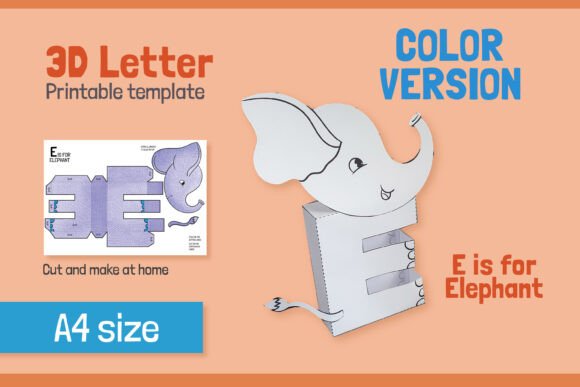
For freelancers, teachers, and content creators, the utility of this resource lies in its ease of integration into existing workflows. The Letter E 3D Papercraft for Kids – COLOR is designed with accessibility in mind. It includes an A4 page printed at 300 dpi, ensuring high-quality output that reflects professionalism. The availability of both JPEG and PDF formats accommodates various technical preferences and printing capabilities. This flexibility is crucial in a diverse market where users may have different hardware setups or software preferences.
Moreover, the inclusion of a PDF file with a link to an assembly video demonstrates an understanding of modern support structures. In the professional world, documentation and tutorial access are key to user satisfaction. By providing a visual guide, the creators of this papercraft reduce friction and lower the barrier to entry. This approach mirrors best practices in customer success and user onboarding. For entrepreneurs developing their own products, this serves as a case study in reducing customer support burdens through proactive resource provision.
- Preparation: Print the A4 page on cardstock for durability, ensuring the 300 dpi resolution is maintained for crisp edges.
- Precision Cutting: Use safety scissors to cut along the solid lines, emphasizing careful handling to build fine motor control.
- Folding: Fold along the dashed lines, using a bone folder or ruler edge for sharp, professional-looking creases.
- Assembly: Apply glue to the designated tabs, following the video guide to ensure structural stability.
- Display: Once dry, the 3D elephant can be used as a classroom decoration or a personal learning aid.
The Role of Color in Engagement and Retention
The decision to offer a COLOR version of the papercraft is strategic. Color psychology plays a significant role in learning and memory. Vibrant hues attract attention and stimulate interest, which is essential for maintaining focus in young learners. For designers and marketers, this underscores the importance of visual appeal in product adoption. The elephant model is not just gray; it is an invitation to explore color theory, shading, and artistic interpretation. This creative freedom allows children to make the project their own, fostering a sense of ownership and pride.
In a broader context, this reflects a shift towards personalized learning experiences. Just as businesses customize their offerings to meet individual client needs, educational tools are evolving to allow for customization. The Letter E 3D Papercraft for Kids – COLOR supports this by providing a base structure that can be modified, decorated, or integrated into larger projects. This adaptability makes it a versatile asset for therapists, teachers, and parents who seek to tailor activities to specific developmental goals.
Market Relevance and Consumer Expectations
Why are people paying attention to such specific crafting tools? The answer lies in the desire for meaningful, offline activities. As digital fatigue becomes a recognized phenomenon, there is a renewed appreciation for analog processes. Consumers are seeking products that offer a break from screens while still providing educational value. The Letter E 3D Papercraft for Kids – COLOR meets this demand by offering a high-quality, engaging alternative to digital games.
Additionally, the rise of the "maker movement" has influenced consumer preferences. People are increasingly interested in understanding how things are made and participating in the creation process. This trend is evident in industries ranging from food to fashion. In the educational sector, it manifests as a preference for hands-on kits over passive toys. For entrepreneurs, this signals an opportunity to develop products that empower users to create rather than just consume. The success of such papercrafts indicates a market ready for innovative, tactile learning solutions.
Conclusion: Investing in Tangible Skills
The Letter E 3D Papercraft for Kids – COLOR is more than a simple craft kit; it is a reflection of evolving educational priorities and consumer values. It bridges the gap between fun and function, offering a practical way to develop essential skills while engaging with core academic concepts. For professionals across various industries, it serves as a reminder of the power of tactile learning and the importance of designing products that respect the user’s intelligence and creativity.
As we look to the future of education and product design, the integration of physical making with digital support—such as the included video tutorial—will likely become standard. This hybrid approach maximizes accessibility and effectiveness. By choosing resources like this, parents, educators, and creators are not just buying a paper model; they are investing in a methodology that values precision, creativity, and deep engagement. The elephant stands as a symbol of this robust, multifaceted approach to learning, proving that even the simplest tools can have a profound impact when designed with insight and purpose.