Strategic Visual Communication: Leveraging 3D Home and Fun Symbols Icons for Brand Clarity
In the crowded digital landscape, visual clarity is not merely an aesthetic preference; it is a strategic imperative. Whether you are designing a user interface for a fintech app, crafting social media assets for a lifestyle brand, or preparing print materials for a corporate event, the speed at which your audience processes information determines your success. This is where high-quality visual assets become critical tools rather than decorative afterthoughts. Specifically, the integration of 3D Home, Fun Symbols Icons offers a unique opportunity to bridge the gap between professional polish and approachable engagement.
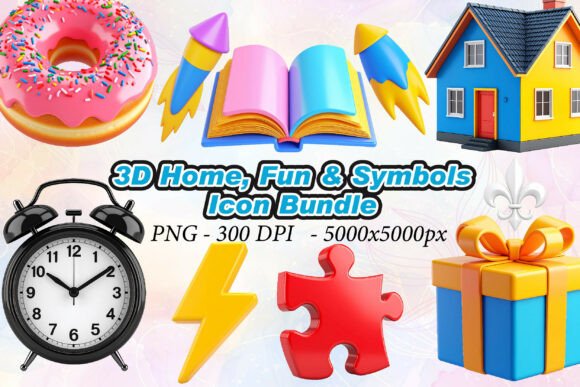
These are not generic clip-art solutions. We are discussing a curated collection of high-resolution 3D icons, rendered with precision at 5000x5000 pixels and 300 DPI. The technical specifications matter because they dictate versatility. A transparent PNG background means no time wasted on manual extraction, while the massive resolution ensures that whether you are scaling down for a mobile button or blowing up for a trade show banner, the integrity of the image remains intact. But beyond the technicalities, the strategic value lies in how these assets influence perception, trust, and user behavior.
The Psychology of Depth and Playfulness in Professional Design
Flat design has dominated the web for over a decade, prioritizing minimalism and load speeds. However, as interfaces have become increasingly uniform, users have developed a certain level of "banner blindness" to standard two-dimensional graphics. The introduction of 3D elements reintroduces depth, texture, and tangibility to digital spaces. When you utilize 3D Home, Fun Symbols Icons, you are tapping into a psychological cue that suggests substance. A 3D-rendered home icon feels more like a physical object one can interact with, which subtly increases the perceived value of the service or product it represents.
Furthermore, the "fun" aspect of these symbols is not about being childish; it is about being human. In an era where automation and AI dominate customer interactions, brands that inject warmth and personality stand out. Vibrant colors and soft, rounded 3D forms reduce cognitive friction. They make complex services feel accessible. For educators and content creators, this translates to higher engagement rates. For entrepreneurs, it means lower bounce rates on landing pages. The key is intentionality. You are not adding 3D elements to be trendy; you are using them to lower the barrier to entry for your audience.
Technical Precision as a Foundation for Scalability
One of the most common pitfalls in creative operations is asset management. Designers often find themselves scrambling for higher-resolution versions of icons when a project scope expands from web-only to print. This inefficiency kills productivity and compromises quality. By starting with a collection designed at 5000x5000 pixels with a transparent background, you future-proof your creative workflow.
Consider the practical implications for a small business owner or marketing manager. You might initially use a 3D home icon for a website header. Six months later, you decide to launch a direct mail campaign. Because your source assets are high-resolution PNGs at 300 DPI, you do not need to commission new artwork or deal with pixelation issues. The same asset works seamlessly across digital screens and physical paper. This consistency reinforces brand recognition. When your visual language is consistent across touchpoints, you build trust. Customers subconsciously recognize the quality and care put into your materials, which reflects on the quality of your core offerings.
Strategic Applications Across Industries
To maximize the return on investment for these visual assets, it is essential to map them to specific business goals. Here is how different professionals can leverage this collection strategically:
- Real Estate and Property Tech: For platforms listing homes or managing rentals, 3D home icons provide an immediate visual anchor. They distinguish your platform from competitors using generic flat vectors. Use these icons in app navigation, email newsletters, and feature highlights to create a cohesive, premium feel.
- Educational Content and E-Learning: Educators know that engagement drops when material feels dry. Incorporating fun, vibrant 3D symbols into slide decks, worksheets, and online course interfaces can break up text-heavy content. The high resolution ensures that printed handouts look crisp, maintaining professional standards even in academic settings.
- SaaS and User Interface Design: Product managers and UX designers can use these icons to guide user attention. A 3D icon stands out against a flat background, making it ideal for call-to-action buttons or key feature indicators. The transparency allows for easy integration into dark or light modes without additional editing.
- Social Media and Branding: In the feed economy, stopping the scroll is half the battle. Bright, colorful 3D graphics perform exceptionally well on platforms like Instagram and LinkedIn. They convey energy and modernity. Using a consistent set of icons helps establish a recognizable visual identity, making your posts instantly identifiable even before the user reads the handle.
Risks of Unintentional Design
While the benefits are significant, there are risks associated with using high-impact visuals without a clear strategy. The primary danger is visual clutter. Because 3D icons are rich in detail and color, they demand attention. If you overload a page with too many competing 3D elements, you dilute their impact and overwhelm the user. The goal is emphasis, not noise.
Another risk is misalignment with brand tone. While "fun" symbols are versatile, they must fit the context. A law firm might use subtle, muted 3D icons to convey stability, whereas a children’s toy brand might opt for the brightest, most playful variants. Using 3D Home, Fun Symbols Icons requires an understanding of your audience’s expectations. If the visual style clashes with the message, it creates cognitive dissonance, leading to distrust. Always ask: Does this icon clarify the message, or does it distract from it?
Decision-Making Framework for Asset Selection
Before integrating these icons into your next project, consider the following decision-making framework to ensure strategic alignment:
- Define the Objective: Are you trying to inform, entertain, or convert? For conversion-focused pages, use 3D icons sparingly to highlight key benefits. For educational or entertainment content, you can be more liberal with their use to maintain interest.
- Audit Your Current Visual Language: Look at your existing website, brochures, and social media. Is there a gap in warmth or dimensionality? If your current assets feel cold or outdated, introducing 3D elements can revitalize your brand perception.
- Test for Clarity: Because these icons are detailed, ensure they remain legible at smaller sizes. While the 5000x5000 px source file is huge, your end-use might be a 32x32 pixel favicon. Test the scalability. The high quality of the render should allow for clear recognition even when scaled down, but always verify.
- Ensure Consistency: Do not mix 3D icons with flat line art unless you have a very sophisticated design system that justifies the contrast. Stick to the 3D style for a unified look. This collection provides a cohesive set, so leverage that unity to strengthen your brand identity.
Long-Term Value and Operational Efficiency
Investing in high-quality assets is an operational decision as much as a creative one. Time is a finite resource for freelancers, agencies, and in-house teams. Searching for free icons, dealing with low-resolution downloads, and spending hours removing backgrounds in Photoshop adds up. By utilizing a ready-to-use collection of 3D Home, Fun Symbols Icons with transparent backgrounds, you eliminate these friction points.
This efficiency allows you to focus on higher-value tasks: strategy, copywriting, and user experience optimization. Moreover, having a library of premium assets on hand enables rapid prototyping. You can test different layout concepts quickly without waiting for custom illustrations. This agility is crucial in fast-moving markets where being first to market with a polished product can determine success.
Ultimately, the choice to use high-resolution 3D icons is a choice to prioritize quality and clarity. It signals to your audience that you pay attention to details. In a world where digital interactions are often transient, creating moments of visual delight and clarity can foster deeper connections. Whether you are building a brand from scratch or refreshing an established identity, these tools offer the precision and vibrancy needed to communicate effectively. Use them not just to decorate, but to deliberate, guide, and engage.