Letter C 3D Papercraft for Kids – COLOR: A Hands-On Learning Tool
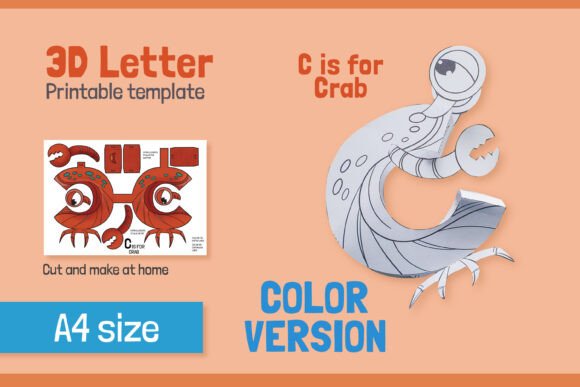
There is a distinct difference between recognizing a letter on a flashcard and physically constructing it. When children engage with Letter C 3D Papercraft for Kids – COLOR, they are not just memorizing the alphabet; they are experiencing the shape, structure, and spatial reality of the character. This specific design features a vibrant crab, turning the abstract concept of the letter "C" into a tangible, colorful creature that stands up off the page. For parents, educators, and caregivers looking to bridge the gap between passive screen time and active learning, this resource offers a compelling, low-tech solution that fits seamlessly into modern educational routines.
Transforming Abstract Letters into Tangible Objects
Early literacy development relies heavily on multisensory experiences. While digital apps can teach phonics, they rarely develop the fine motor skills required for writing. The process of creating this papercraft involves cutting along precise lines, folding along scored edges, and gluing tabs together. These actions are foundational for hand-eye coordination and dexterity. When a child manipulates the paper to form the curved body of the crab, they are internalizing the curve of the letter "C" in a way that tracing on paper simply cannot replicate.
The COLOR version of this craft adds another layer of engagement. Unlike black-and-white templates that require additional coloring time, the pre-colored design allows for immediate assembly and visual satisfaction. The high-resolution 300 dpi JPEG ensures that when printed on standard A4 paper, the colors remain crisp and appealing. This vibrancy is crucial for maintaining a child’s interest, especially for those who might find monochrome activities less stimulating. The result is a bright, cheerful crab that serves as both a learning aid and a decorative piece.
Practical Applications in Home and Classroom Settings
The versatility of this papercraft extends far beyond a simple afternoon activity. Its utility varies significantly depending on the environment and the goals of the user.
For Homeschooling Parents
In a homeschool setting, thematic units are common. If you are studying marine life, ocean conservation, or simply the letter of the week, this crab becomes a central artifact of the lesson. It serves as a physical anchor for discussions about sea creatures, habitats, and alphabetical order. Because the download includes a PDF with a link to an assembly video, parents do not need to be crafting experts to guide the process. This reduces preparation stress and allows the focus to remain on interaction and learning rather than troubleshooting instructions.
For Classroom Teachers
Teachers often face the challenge of managing diverse skill levels within a single classroom. This project is scalable. Younger students may need assistance with cutting, focusing instead on the folding and gluing aspects, while older students can handle the entire process independently. Once assembled, these crabs can be used to create a dynamic classroom display. Imagine a bulletin board featuring twenty different 3D crabs, each made by a different student. This not only celebrates individual effort but also creates a visually striking environment that reinforces letter recognition daily. The 3D nature of the craft makes it stand out against traditional flat drawings, capturing the attention of visitors and students alike.
For Occupational Therapy and Skill Development
Beyond literacy, this craft is a valuable tool for developing fine motor skills. Occupational therapists often use paper crafts to help children improve their pincer grasp, bilateral coordination (using both hands together), and spatial awareness. The act of folding requires precision and patience, while gluing demands control to avoid messes. For children who struggle with handwriting, the muscle memory developed through these crafting activities can translate to better pencil control. The clear, bold lines of the Letter C 3D Papercraft for Kids – COLOR provide necessary visual cues that help guide these movements.
Navigating the Assembly Process
One of the most significant barriers to entry for paper crafts is the fear of complexity. Many adults hesitate to introduce 3D projects because they anticipate frustration. However, this specific design mitigates that risk through thoughtful resource inclusion. The provision of a video tutorial via the PDF link is a game-changer. Watching a pair of hands fold and glue the pieces in real-time is infinitely more helpful than static diagrams. It allows users to pause, rewind, and mimic the movements at their own pace.
Before starting, it is important to consider the materials. While the template is designed for standard A4 paper, using slightly heavier cardstock can yield a sturdier final product that holds its shape better over time. However, standard printer paper works perfectly well for immediate use or if younger children are struggling with thicker materials. Scissors should be sharp enough to make clean cuts but safe for children if they are doing the cutting themselves. A glue stick is generally preferred over liquid glue, as it causes less warping of the paper and dries faster, keeping the momentum of the activity going.
Strengths and Considerations
The primary strength of this papercraft lies in its dual focus on aesthetics and education. The crab design is inherently playful, which lowers the resistance children might feel toward academic tasks. The pre-colored aspect saves time and ensures a professional-looking result, which boosts the child’s confidence. Furthermore, the digital format means instant access; there is no waiting for shipping, and you can print multiple copies if mistakes happen or if you want to create a whole colony of crabs.
However, there are limitations to keep in mind. This is a screen-free activity that requires initial setup. Printing, cutting, and organizing the pieces take time. It is not an instant gratification toy. Additionally, while the video guide is helpful, it does require a device to view during assembly, which introduces a small amount of screen time into the process. Users should plan for this by having a tablet or phone ready before starting the craft.
Another consideration is age appropriateness. While the craft is designed for kids, children under five will likely need significant adult supervision, particularly for the cutting phase. The small tabs and precise folds can be challenging for undeveloped hands. For this demographic, the activity becomes a collaborative bonding experience rather than an independent task. For older children, aged six to nine, it serves as an excellent independent project that fosters patience and attention to detail.
Integrating Craft into Daily Learning
To maximize the value of the Letter C 3D Papercraft for Kids – COLOR, consider integrating it into a broader learning narrative. After assembling the crab, ask open-ended questions. What sound does "C" make? Can you think of other words that start with "C"? Where do crabs live? This transforms a simple craft into a springboard for vocabulary building and scientific inquiry. You might even encourage the child to name their crab and write a short story about its adventures, further reinforcing literacy skills.
Ultimately, this papercraft is more than just a cut-and-paste activity. It is a tool for engagement, a builder of skills, and a creator of memories. Whether used in a bustling classroom, a quiet homeschool corner, or a therapy session, it brings the letter "C" to life in a way that is both educational and deeply enjoyable. By combining the tactile satisfaction of crafting with the cognitive benefits of letter recognition, it offers a holistic approach to early learning that resonates with both children and the adults who guide them.